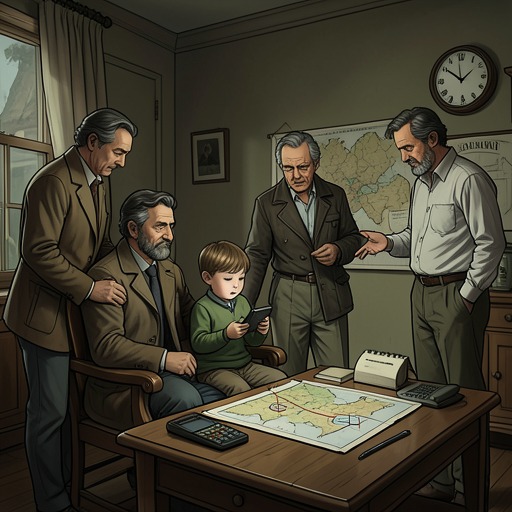
Malorie's blindfolded journey to find a microphone
Bird BoxMalorie's blindfolded journey to find a microphone is a perilous attempt to bring useful equipment back to the house, undertaken while she is caring for newborns and still recovering from childbirth. It carries the housemates’ strategies for survival into unfamiliar streets, then overturns one of their most important assumptions: Victor, sent to guide and protect her, becomes distressed in the bar, and Malorie returns with the microphones but learns that dogs are not immune to the creatures’ effects.
Purpose and Preparation
Tom had proposed a plan for leaving the house under blindfolds: protective helmets, butcher knives, and dogs that could lead the group. The plan depended on treating the dogs as guides while accepting that an animal might become dangerous. Malorie’s journey puts that general idea into practice on a smaller, solitary scale. She needs microphones, and she undertakes the trip while two newborns remain at home.
The vehicle is prepared to prevent sight through the windshield. Malorie paints the glass black with paint from the cellar, then tapes socks and sweaters to its inside. She also fastens blankets and mattresses to the bumpers using wood glue from the garage and duct tape from the cellar. The improvised barriers do not make driving safe; they turn it into a task governed by touch, sound, memory, and painfully limited control.
Victor is part of the plan because Malorie believes he can help her. Jules had previously refused to let Victor be used in that way, but the circumstances have changed: Malorie has newborns to care for, and she is in pain and exhausted after giving birth. She plans to leave the babies at home, drive to the bar, bring food for Victor, and rely on him to guide her between the destination, the car, and the supplies. Her decision is practical, but it also makes the dog her companion in a journey whose hazards she cannot see.
Driving Without Sight
Malorie estimates a route of several miles and imagines travelling at five or six miles an hour. The first attempt disabuses her of any confidence that caution alone can control the trip. The Wagoneer bounces as it strikes unidentified obstacles; she hits the curb twenty times, poles twice, and a parked car once. She returns without the equipment and unsure whether she can bring herself to try again.
She does try again. On her seventh attempt, she finds a Laundromat she remembers from her first drive to the house, and that recognition gives her enough confidence to continue. Blindfolded, she enters several businesses: a boot store, a coffee shop, an ice-cream parlor, and a theater. In an office lobby, the sound of her shoes against a marble floor helps locate her in the space; elsewhere, she knocks a shelf of greeting cards to the floor. These partial encounters show her learning to navigate by remembered places and sound, but none brings her to the bar.
On the ninth afternoon, she enters an unlocked wooden door and recognizes the bar. The journey’s repetitions matter: she does not master blind driving so much as persist through failed routes until memory and chance deliver her to the place she sought. Her arrival is a limited success, not proof that the method is reliable.
Victor and the Bar
Inside, Malorie drinks rum and briefly welcomes the reprieve. Victor, however, tugs at the leash securing him to a stool. When he continues pulling, she follows his attention and opens a door; a powerful foul odor makes her vomit. She understands the smell as that of a grave and death, and then becomes acutely aware that someone else may be in the room. The bar’s apparent refuge becomes a source of danger, though the evidence does not identify who or what is there.
Malorie pulls Victor back into the bar and ties him to a wooden post, trying to calm him and return to the babies. Instead, he growls with a sound she has never heard from him, and he moves so violently that the post splinters. Victor is not behaving as the steady guide she expected. His distress makes the journey’s reliance on him unstable, while the sound of his struggle leaves Malorie unable to determine what is happening by sight.
The Microphones and the Changed Understanding
Despite her fear and physical pain, Malorie locates a microphone on the stage. She follows a wire to a small square object and discovers three more cords leading to three additional microphones. The equipment is the concrete result of the journey: she gathers what she can and carries it away, even as Victor’s condition worsens. Her attention is divided between obtaining the needed equipment and the urgent knowledge that the dog is in serious distress while the babies remain at home.
After she returns and secures the door, Malorie opens her eyes and rushes to the babies’ room. They are awake, crying, and hungry. Later, she lies shaking on the kitchen floor beside the microphones and two small amplifiers, remembering Victor’s sounds. Her conclusion is explicit and repeated: dogs are not immune; dogs can go mad. Victor’s reaction overturns the expectation that an animal guide can remain outside the catastrophe that endangers people. The equipment reaches the house, but its acquisition costs Malorie the security of believing Victor can protect her, and leaves her with knowledge that changes how she understands the danger to every living creature around her.